

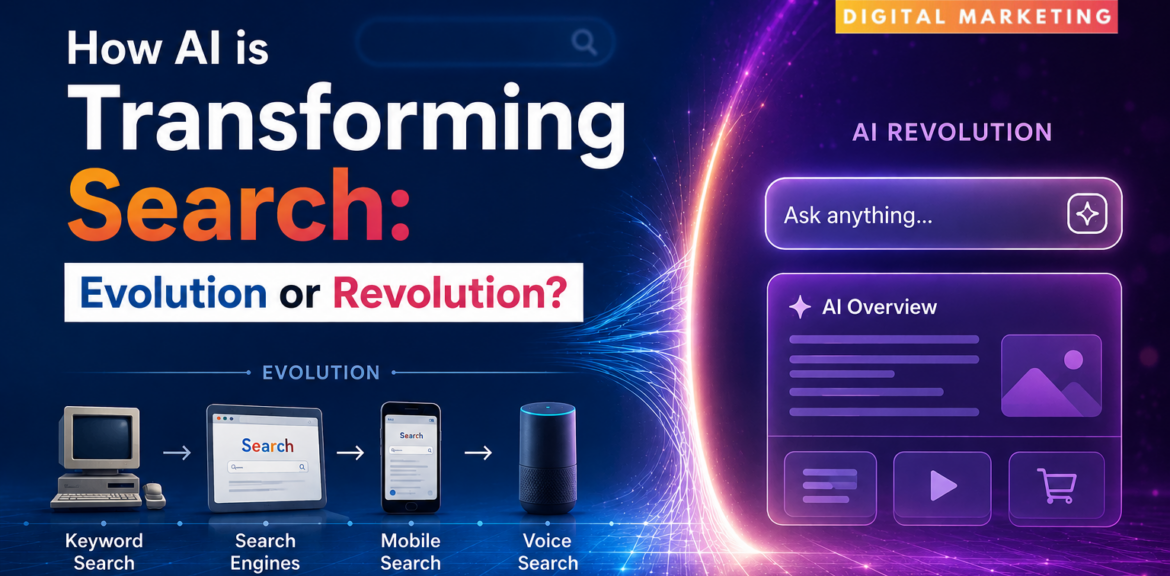

Artificial Intelligence is everywhere right now. From chatbots to smart assistants, it is changing how we interact with technology. One of the biggest transformations is happening in search.
Many people believe AI has suddenly taken over search. In reality, AI has been part of search engines for years. It has quietly worked in the background, improving how results are ranked, how images are understood, and how user intent is interpreted. What we are seeing today is not the beginning, but a powerful new stage.
AI in Search is Not New:
Search engines have always evolved step by step. Long before today’s conversational tools, systems were already using machine learning to understand queries better. Over time, this made search more accurate and more helpful.
What has changed now is not just the technology, but how people use it.
Why It Feels Like a Big Shift:
Earlier, people searched using short phrases. Now, they ask full questions. Instead of typing a few keywords, users describe exactly what they need. This shift makes search feel more human and intuitive.
Today, search engines can understand complex intent. Even vague or detailed questions can lead to meaningful answers. This is why many people feel that search has entered a new era.
How Search Actually Improves:
Search does not change randomly. Behind the scenes, there is a structured process. Engineers build new ideas, test them carefully, and compare them with the current system. Human reviewers evaluate the results, and only improvements that clearly perform better are released.
This continuous cycle of testing and improvement has been happening for years. Thousands of small updates have shaped what search is today.
The Role of AI in Modern Search:
Modern AI features build on top of this existing system. They do not replace it completely. Instead, they enhance it.
When you type a query, the system may explore multiple related ideas at once. It gathers information from different directions and combines it into a more complete answer. This allows search to handle more complex and layered questions than before.
The Rise of Conversational Search:
Search is no longer just about finding links. It is becoming a conversation.
Users can now refine their queries, ask follow-up questions, and explore topics more deeply. Instead of searching multiple times, they can interact with the system in a more natural way.
This makes search feel less like a tool and more like a guide.
A New Search Experience:
Modern search experiences often include summaries that combine information from multiple sources. These summaries help users understand a topic quickly.
At the same time, conversational features allow users to go deeper when needed. This combination of quick answers and deeper exploration creates a more flexible experience.
Changing User Behavior:
As search becomes more intelligent, user behavior is changing. People are asking longer questions and expecting clearer answers. They are exploring topics in more detail and relying on search to guide their decisions.
This shift is creating new opportunities, but also new challenges for websites and businesses.
What This Means for Content Creators:
There is growing concern about how AI will impact website traffic. While the landscape is changing, one principle remains the same: value matters.
Content that truly helps users will always have a place. If a website offers useful information, real insights, or meaningful experiences, people will continue to visit it.
Simply repeating basic information is no longer enough. Users expect depth, clarity, and authenticity.
The Importance of Human Value:
AI makes it easy to generate content quickly. But not all content is valuable.
Information that simply repeats what is already available does not stand out. What makes content meaningful is human perspective. Real experiences, honest opinions, and unique insights are things AI cannot fully replicate.
This is where creators have an advantage.
Using AI the Right Way:
AI should be seen as a tool, not a replacement. It can help improve writing, organize ideas, and speed up work. It can support creativity, but it should not replace it.
The best results come when human thinking and AI capabilities work together.
Looking Ahead:
Search will continue to evolve. AI will become more advanced and more integrated into everyday experiences. But the core idea will not change.
People will always look for content that is useful, reliable, and meaningful.
Final Thoughts:
AI is not replacing search. It is transforming it.
It is making search more natural, more powerful, and more accessible. At the same time, it is raising the standard for what good content looks like.
In the end, success will not depend on technology alone. It will depend on the ability to create real value and connect with people in a meaningful way.
